LEICA & LILACS
In 1973 National Geographic Magazine offered me an assignment in Latvia. There was a condition that if anything happened to me, they could not help as it would jeopardize negotiations for other Soviet visas.
Though I was working as a photojournalist and commercial photographer, I was also teaching photography. This allowed me to fill out my Intourist visa application as a college art professor. I simply ignored Soviet restrictions regarding one camera and 10 rolls of film that could be brought in and arrived with 2 bodies, 5 lenses and 50+ rolls of film.
Tourists were restricted to Riga itself. The scenic beauty of Vecriga (Old Riga) was what many visited to see. I had no access to the daily lives of Latvians that the magazine wanted documented. My photos were never published. However, my uncle, Peteris Upitis, was a renowned horticulturist I wanted to visit. Unfortunately, his research gardens were in Dobele which was in a restricted heavily militarized zone southwest of Riga.
My uncle had previously gifted a Polaroid camera and film to a Soviet official years earlier to get a visa to visit the US. His visa was granted, then retracted, as he was too useful to the State and might never return. The visa was transferred to his brother who was able to visit the US.
Meanwhile the Soviet official had run out of polaroids so the additional film I had brought along enabled my uncle to secure transport to enable me to visit him twice.
Today my uncle’s gardens and research labs have expanded beyond anything he could have envisioned. There is a museum in his honor. As I archived my old work, I realized the museum only had a select few photos of my 1973 visits. I edited down to my best 24 photos and sent them high resolution files embedded with information about each photo as well as notes about my visits.
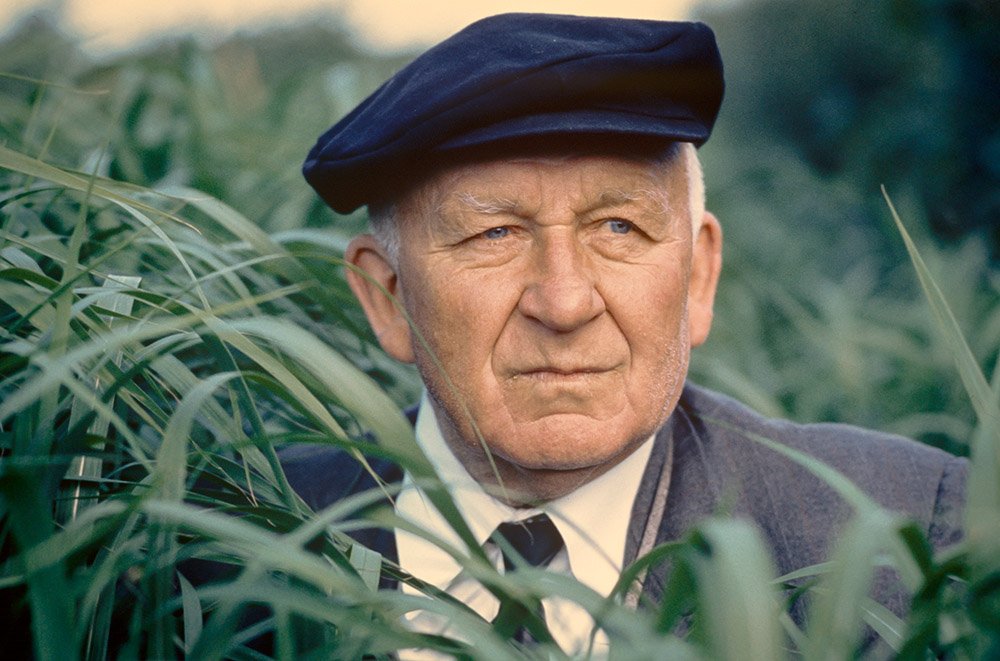
Peteris Upitis Dobele 1973
The museum was thrilled to get the photos as well as my stories. They asked if I spoke Latvian to my uncle (yes), how did I get there, what was my impression of him and his work? I assumed they would be archiving or perhaps adding a few photos to the museum display. Instead, they planned a large outdoor display of my work commemorating my uncle’s 130th birthday. I was invited! My family had had discussions about a trip to Latvia, and we began to organize and coordinate a visit. For me the key things to see and do were: 1) See the iconic old Riga, founded in1201. 2) Visit my uncle’s gardens and museum and 3) Visit my parent’s manor house which they fled in 1944.
As with every trip I have ever taken in my life, the first decision was what cameras would I take? Lately, I’ve traveled with the M-11P and the incredible 35mm Apo-Summicron. But I thought the tight confines of old Riga and wide-open spaces would need a wider and sometimes longer lens, so I decided on a Sony camera and zoom. During nighttime ruminations my dad’s IIIc Leica jumped out at me. With this camera he had documented leaving Germany, entering and establishing family life in the USA. Sometime in the late 1940’s my dad purchased the Leica with 3 lenses. He used it to record our train trip to the boat that would take us to America, entering NY Harbor and reaching our sponsor’s family in New York. Wouldn’t it be great to use that very camera to revisit the land he fled?
I did quick test roll to confirmed shutter speeds were true. Still unsure, I ran the idea past a few old friends who were very supportive of the idea. I decided to use the camera with the added discipline of only taking two rolls of film.
I started with landing shots into Riga airport, the views of the city itself included sites I had first seen in 1973 and then again in 1990 with my father when we had a family photo show in Pulvertornis.
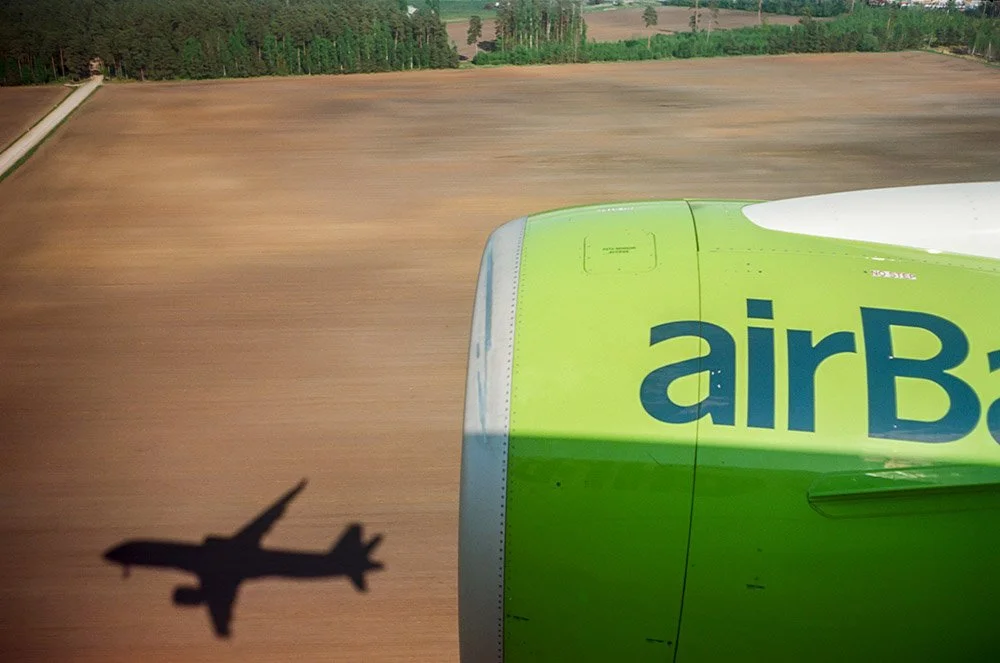
Landing In Riga, Latvia
Then it was on to Dobele and my uncle’s research farm where his 300 hybrids of lilacs were in full bloom. All the correspondence with Museum Director Agnija Berke resulted in a most beautiful day. Being able to plant his most famous white lilac (Mate Ede Upitis) by all family members was especially meaningful to me. I had my 12-year-old grandson use the Leica as I planted my lilac. My uncle’s dream was for Latvia to be a lilac garden. As we traveled the countryside there were lilacs in bloom everywhere.
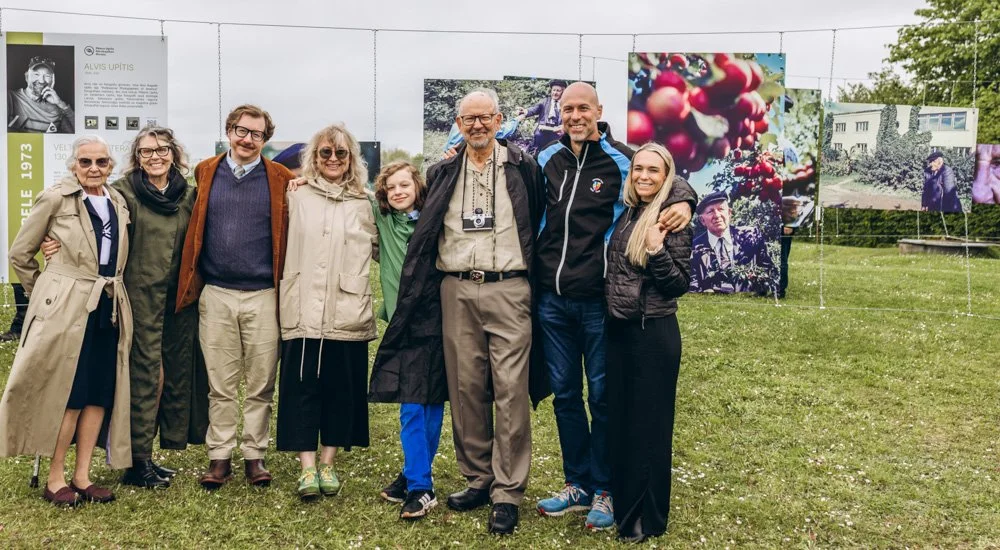
Family At Dobele Show/Courtesy Krause Vision
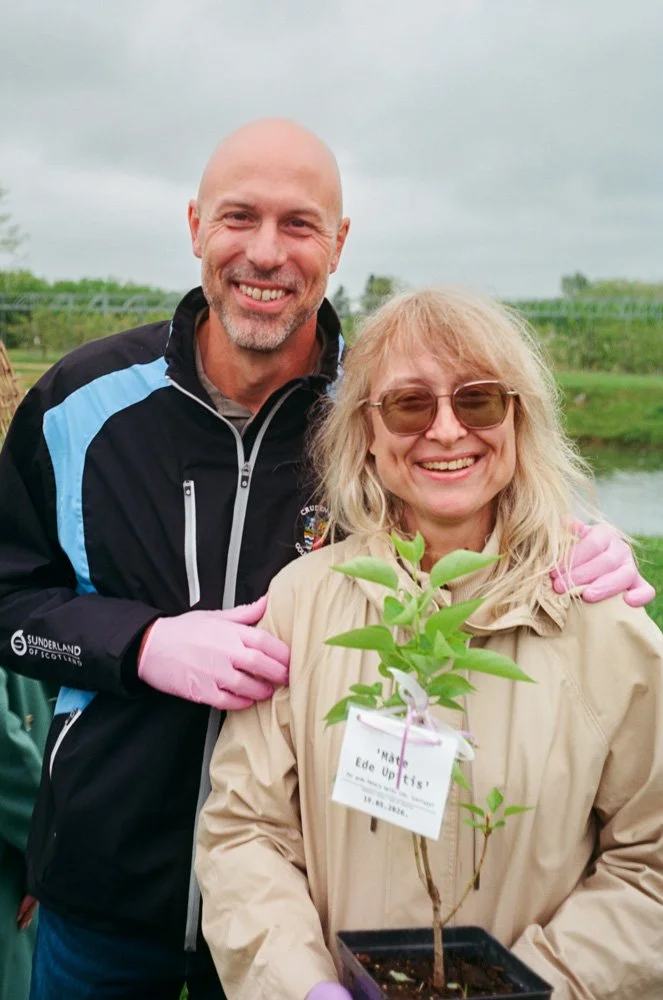
Dris & Alise & Mate Ede
Our visit to the area where my family had lived, Jumurda, was a surprise. We learned how esteemed our family was locally with library displays on my uncle’s and my dad’s birthdays. Library Director Agita Opincane was most gracious in making us all feel welcomed. A visit to the grandparents’ grave site in a beautiful well maintained rural cemetery moved us all. On the headstone was inscribed that they were Peteris’ parents and the iconic Mate Ede lilac was planted in the corner of the large plot. We were all hesitant to walk on the manicured sand, but our host assured us the ancestors would rejoice at the sign of footprints visiting them.
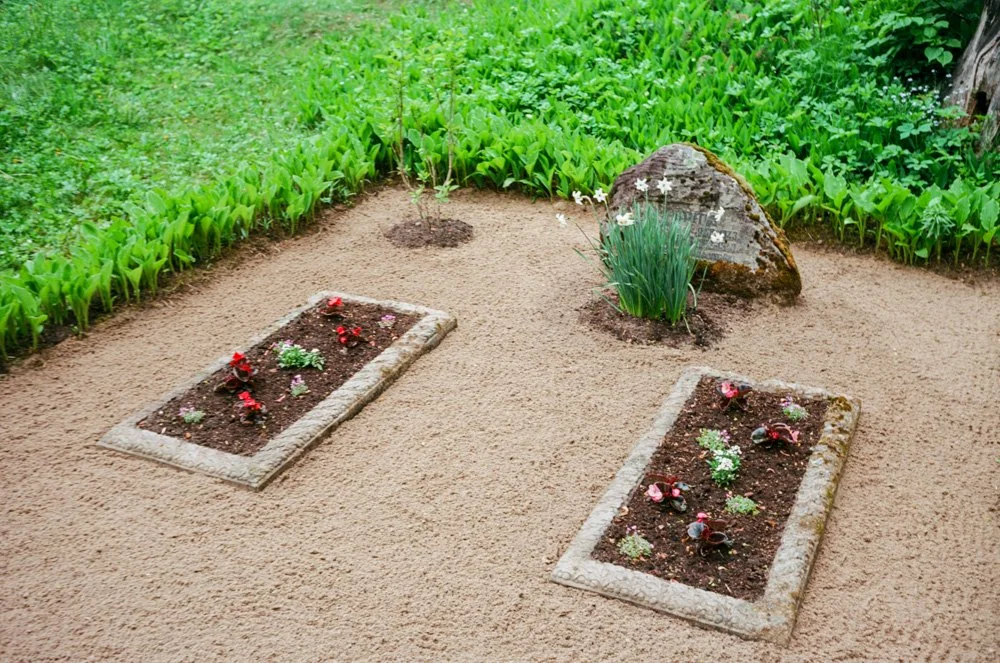
Janis & Ede Upitis in Jumurda
We went on to Gulbere (“place of the swan”), which was once a German Baron’s manor house when Latvians were serfs on their own land. Built with 20 rooms, including a ballroom and large basement where a well is still used by the neighbors. The rooms are in various states of ruin with a single person living in one small area. The foundations of the seven greenhouses my parents built along with a chimney for a heating plant are all that remain of a thriving enterprise. We were overwhelmed by what it all once was and what it is now. My parents had fled Latvia giving up everything they had built. But we survived and thrived as a family. My children and grandchild are the joyful evidence.
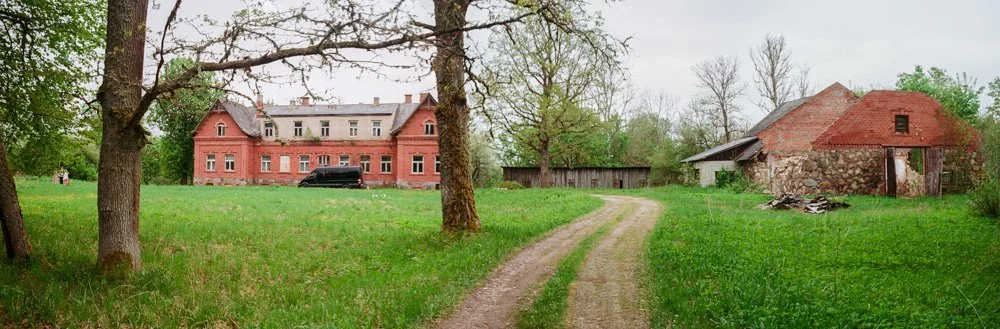
Gulbere Manor House
Our bonus last stop was Ergli, the city of my father’s Christmas Eve christening. It was destroyed in WWII and rebuilt in the 1950’s. It is the site of a famous German Castle overlooking the –Orgre River. My father’s favorite author was Rudolfs Blaumanis and Ergli is the city of his birth. I took my grandson’s photo at a Blauman statue with exactly the right camera.
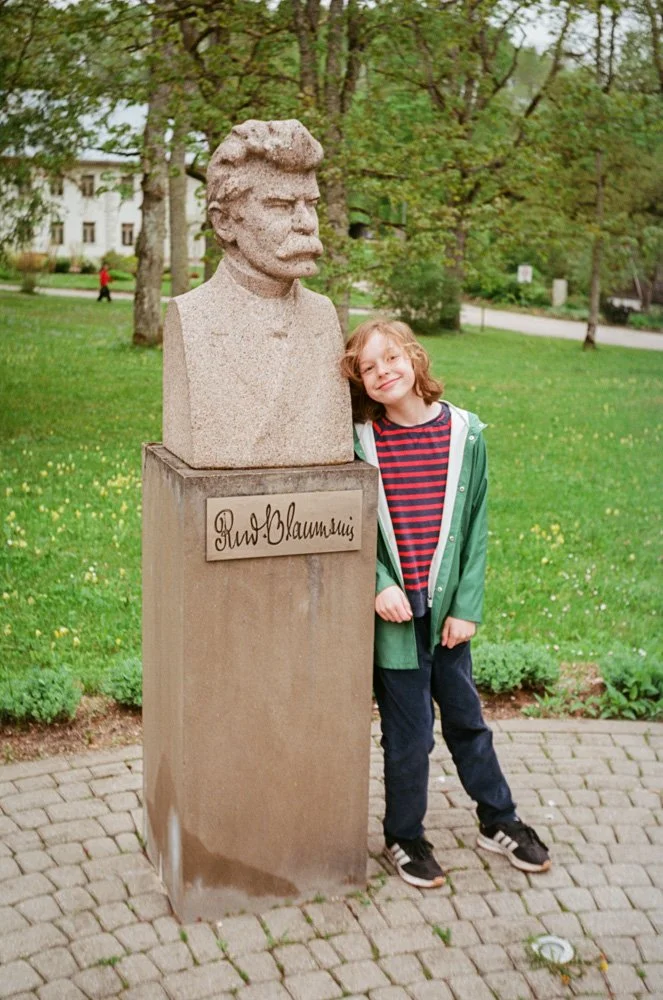
Blaumanis & Otomars
My uncle had learned photography in the military during WWI. On returning home he taught the basics to his two brothers. Valdemars became a well known Riga photographer and film director in the 1930’s. My father most remembered one key phrase my uncle shared about photography. “Should you ever find yourself in a foreign land, this is skill that may prove useful.”
Indeed, it did. My father used his Leica to further refine his skills and moved from job to job until he opened his own successful Color Studio in Poughkeepsie, NY.
Using my dad’s old camera in a slower purer form of photography humbles me.
Alvis Upitis